Hedge plants that combine function and aesthetics


Hedge plants that combine function and aesthetics
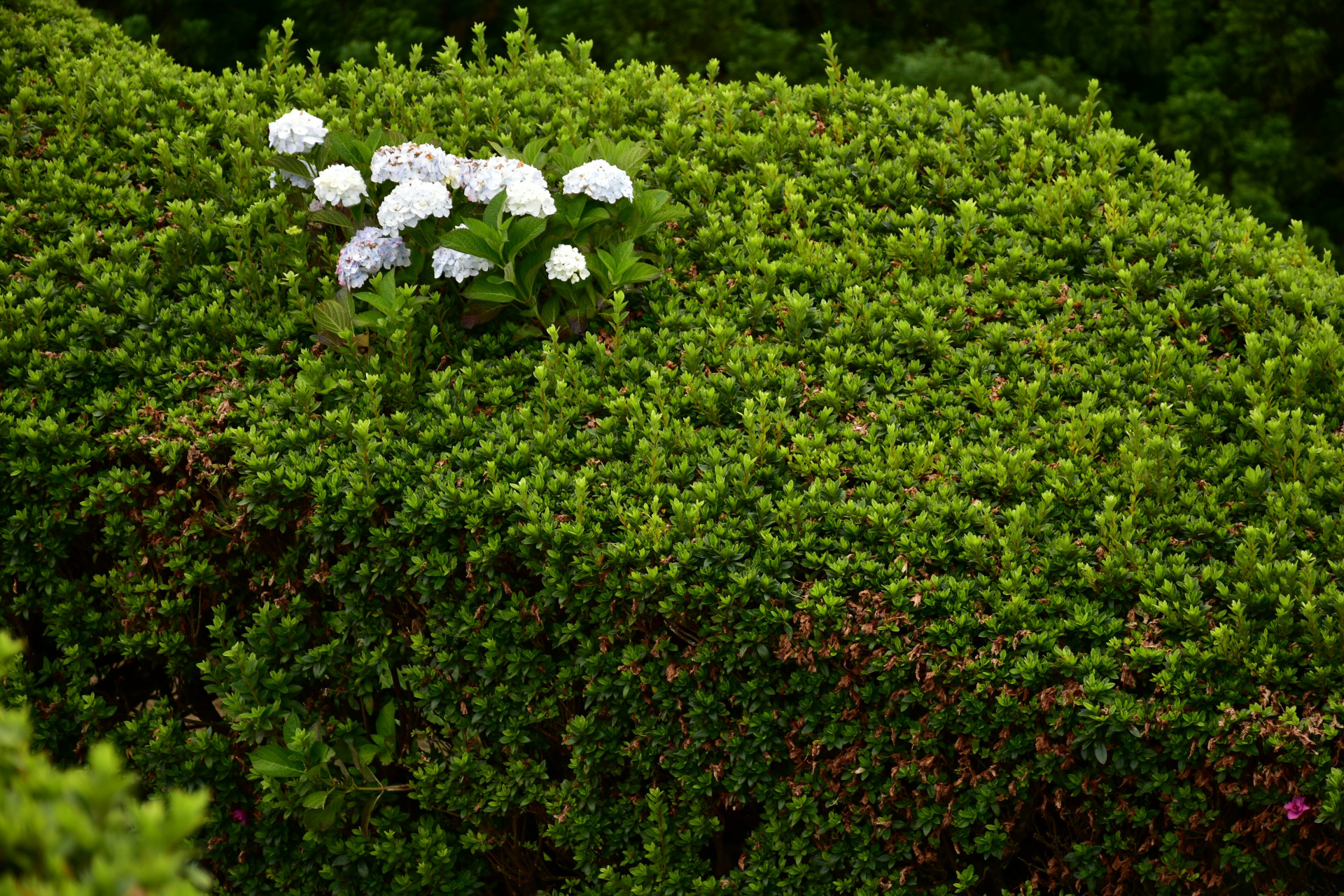
Hedge plants are much more than just a natural boundary for the garden. They can serve as living fences, provide shelter from the wind, reduce noise, and at the same time add a beautiful and lush expression to the garden all year round. The choice of hedge plant depends on both practical and aesthetic considerations – should the hedge be evergreen, flowering, fast-growing, or perhaps attract birds and insects?
In this article, you will get an overview of different types of hedge plants and their characteristics, so that you can find the solution that best suits your garden and your preferences.
The article presents a selection of popular and versatile hedge plants that represent different types and functions – from classic evergreen hedges to deciduous varieties with seasonal variation. The goal is to provide an informative overview of the possibilities, making it easier for you to assess which type of hedge suits your garden’s style and needs. The information about the plants is based on descriptions from producers and retailers and is summarised to give a clear and inspiring insight.
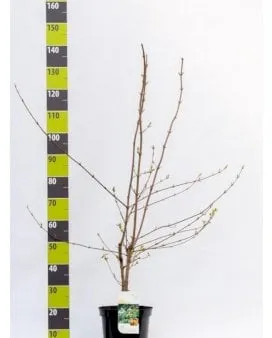
Field Maple Hedge, also known as Acer campestre, is a native species that is particularly adapted to the Norwegian climate. It is easy to grow and tolerates both pruning and varying growth conditions. Without pruning, the plant develops into a small tree with dense and branched growth, but it can also be shaped into a compact hedge.
The leaves are small and three- to five-lobed with rounded edges. They appear bronze-coloured when emerging, later becoming dark green to blue-green and turning golden yellow in autumn. The bark is greyish to light green with characteristic cork ridges that give a decorative appearance, especially on older branches.
In May, the Field Maple Hedge blooms with small, light green flowers that attract bees and other pollinators. After flowering, small winged fruits form, which are eaten by birds during the winter.
The plant thrives in almost all soil types, including where the soil can periodically be moist. It tolerates both sun and shade and can be used as a clipped hedge, unclipped shelter planting, or as a free-standing small tree. When planting, it is recommended to use soil improvement and regular watering to ensure good establishment.
- Hardy and native: Tolerates the Norwegian climate and requires minimal care.
- Dense growth: Forms wind-resistant and compact hedges, even under less optimal conditions.
- Versatile uses: Suitable for both clipped and unclipped hedges as well as free-standing trees.
- Bee-friendly flowering: Small flowers in May provide pollen and nectar for bees.
- Decorative bark and foliage: Cork ridges on the branches and beautiful autumn colours.
Pros and cons
- Very hardy and easy to grow
- Thrives in both sun and shade
- Tolerates pruning and shaping
- Bee- and bird-friendly
- Suitable for many soil types
- Requires regular trimming to maintain a dense form
- May grow slowly during the establishment phase
- Needs watering during dry periods after planting
Pros and cons
Pros
- Very hardy and easy to grow
- Thrives in both sun and shade
- Tolerates pruning and shaping
- Bee- and bird-friendly
- Suitable for many soil types
Cons
- Requires regular trimming to maintain a dense form
- May grow slowly during the establishment phase
- Needs watering during dry periods after planting
Pros
- Very hardy and easy to grow
- Thrives in both sun and shade
- Tolerates pruning and shaping
- Bee- and bird-friendly
- Suitable for many soil types
Cons
- Requires regular trimming to maintain a dense form
- May grow slowly during the establishment phase
- Needs watering during dry periods after planting
Specifications
- Botanical name: Acer campestre
- Type: Deciduous hedge plant
- Height: 1000–1500 cm (as a free-standing tree)
- Width: 150–300 cm
- Leaf colour: Dark green to blue-green, yellow autumn colour
- Flowering: May
- Flower colour: Green
- Flowering period: Spring
- Growth form: Rounded crown
- Growth: Vigorous and dense
- Light conditions: Full sun or shade
- Soil type: Most soil types, including moist ones
- Hardiness: Fully hardy
- Use: Clipped or unclipped hedge, shelter planting, free-standing tree
- Planting density: Approx. 4 plants per running metre
- Bee-friendly: Yes
- Fruit/berries: Small winged fruits
- Leaf type: Deciduous
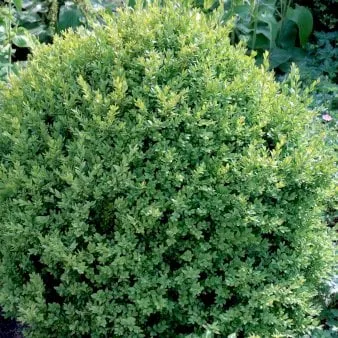
Buxus Sempervirens Var. Arborescens is a variety of the common boxwood, known for its dense and upright growth form. It is often used as a hedge plant or for shaped plantings, where a classic and orderly appearance is desired.
The plant has green, lance-shaped leaves that retain their colour all year round. It thrives best in sun to partial shade and prefers well-drained soil with moderate nutrient content. The growth rate is medium, making it easy to keep in shape and suitable for both low and medium-sized hedges.
With a height of around 100–300 cm and a width of 90–120 cm, Buxus Sempervirens Var. Arborescens can be adapted to many types of gardens and parks. It is fully hardy and tolerates pruning well, making it ideal for structured plantings and classic garden designs.
- Evergreen plant: Retains its green colour all year round.
- Dense growth form: Provides a compact and shape-stable hedge.
- Suitable for topiary: Tolerates pruning and can be shaped as desired.
- Flexible placement: Thrives in both sun and partial shade.
- Hardy: Tolerates the Norwegian climate without problems.
Pros and cons
- Dense and uniform growth that gives an attractive appearance
- Can be shaped and trimmed precisely
- Evergreen and decorative all year round
- Suitable for both small and large hedges
- Grows relatively slowly compared to many other hedge plants
- Requires regular trimming to maintain its shape
- Can be sensitive to boxwood blight in humid environments
Pros and cons
Pros
- Dense and uniform growth that gives an attractive appearance
- Can be shaped and trimmed precisely
- Evergreen and decorative all year round
- Suitable for both small and large hedges
Cons
- Grows relatively slowly compared to many other hedge plants
- Requires regular trimming to maintain its shape
- Can be sensitive to boxwood blight in humid environments
Pros
- Dense and uniform growth that gives an attractive appearance
- Can be shaped and trimmed precisely
- Evergreen and decorative all year round
- Suitable for both small and large hedges
Cons
- Grows relatively slowly compared to many other hedge plants
- Requires regular trimming to maintain its shape
- Can be sensitive to boxwood blight in humid environments
Specifications
- Botanical name: Buxus sempervirens var. arborescens
- Plant category: Hedge plants / Boxwood
- Use: Hedge, border planting, topiary
- Leaf colour: Green, evergreen
- Leaf shape: Lance-shaped
- Growth form: Upright
- Growth rate: Medium
- Placement: Sun / partial shade
- Optimal growing conditions: Partial shade, well-drained soil
- Hardiness: Fully hardy
- Height: 100–300 cm
- Width: 90–120 cm
- Fertilisation level: Medium
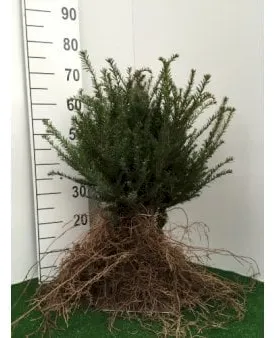
Yew hedge (Taxus baccata) is an evergreen conifer that forms dense, well-branched shrubs with a deep green colour. It is particularly well suited for clipped hedges and topiary figures, as it tolerates even heavy pruning and quickly produces new shoots from old stems.
The plant thrives in both sun and partial shade and does well in most soil types, even where the soil is heavy or less fertile. It is hardy, wind-resistant, and tolerates a certain level of drought, making it well suited to Norwegian conditions.
Female plants can produce small red berries in autumn, which are decorative but poisonous. The flesh around the seed, however, is not poisonous. The yew is native to Norway and the rest of the Nordic region and is known for its long lifespan and ability to maintain a dense, green appearance all year round.
When planting as a hedge, it is recommended to plant about four plants per running metre to achieve dense and even growth. Regular watering and fertilising during the establishment phase promote healthy growth and a stable root system.
- Evergreen and dense: Retains its dark green colour all year round and forms a compact hedge.
- Tolerates pruning: Can be cut back hard and shaped precisely as desired.
- Flexible growing conditions: Thrives in both sun and shade as well as in most soil types.
- Long lifespan: One of the most durable hedge plants for Norwegian gardens.
- Decorative berries: Female plants can produce red berries in autumn.
Pros and cons
- Evergreen and shapeable hedge plant
- Tolerates heavy pruning and shaping
- Thrives in both sun and shade
- Hardy and wind-resistant
- Long lifespan and dense growth
- Grows slowly and requires patience during establishment
- All plant parts except the fruit flesh are poisonous
- Requires regular trimming to maintain shape and density
Pros and cons
Pros
- Evergreen and shapeable hedge plant
- Tolerates heavy pruning and shaping
- Thrives in both sun and shade
- Hardy and wind-resistant
- Long lifespan and dense growth
Cons
- Grows slowly and requires patience during establishment
- All plant parts except the fruit flesh are poisonous
- Requires regular trimming to maintain shape and density
Pros
- Evergreen and shapeable hedge plant
- Tolerates heavy pruning and shaping
- Thrives in both sun and shade
- Hardy and wind-resistant
- Long lifespan and dense growth
Cons
- Grows slowly and requires patience during establishment
- All plant parts except the fruit flesh are poisonous
- Requires regular trimming to maintain shape and density
Specifications
- Botanical name: Taxus baccata
- Plant category: Hedge plants
- Type: Evergreen conifer
- Height (mature plant): 200–300 cm
- Width: 120–150 cm
- Leaf type: Needle-shaped, dark green and leathery
- Flowering: Spring and summer, small golden flowers
- Fruit: Red berries (poisonous except for the fruit flesh)
- Light conditions: Full sun to partial shade
- Wind conditions: Tolerates strong wind
- Soil type: Nutrient-rich, well-drained garden soil; also tolerates heavy or sandy soil
- Hardiness: Fully hardy
- Planting density: Approx. 4 plants per running metre
- Toxicity: Yes
- Bee-friendly: Yes (pollen-rich flowers attract insects)
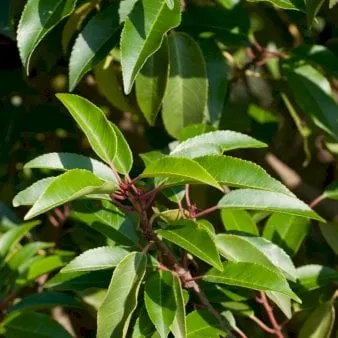
Portuguese laurel, botanically known as Prunus lusitanica 'Angustifolia', is a medium to large evergreen shrub with dense and harmonious growth. It is often used as a hedge plant, where it can be trimmed into an even and compact shape or left untrimmed as a free-growing shrub.
The plant has oval, dark green leaves with a glossy surface that contrasts with the reddish petioles. This colour combination gives an elegant and lively expression in the garden. Early in summer, older plants develop short, upright clusters of small white flowers, followed by black, inedible berries that attract birds.
The growth is moderately vigorous, and the plant rarely exceeds 2.5 metres in height. It thrives best in sheltered locations and in ordinary, nutrient-rich, well-drained garden soil. On heavy clay soil, it may be beneficial to add gravel or sand for better drainage. Regular watering during the establishment phase is important to ensure a good start.
Portuguese laurel is suitable for both sun and shade and can be used as a clipped or unclipped hedge. Its dense growth makes it particularly suitable as a privacy screen, and it retains its green foliage all year round.
- Evergreen: Retains its dark green foliage all year round.
- Decorative contrast: Reddish petioles provide an elegant colour play against the green leaves.
- Suitable for hedges: Can be used as both a clipped and unclipped hedge.
- Blooms in summer: Small white flowers on older plants.
- Robust growth: Moderately vigorous and dense, suitable for sheltered locations.
Pros and cons
- Dense and harmonious growth providing effective screening
- Evergreen and decorative all year round
- Can be shaped as a clipped hedge or left free-growing
- Relatively hardy and less frost-sensitive than other varieties
- May suffer leaf scorch in strong wind or bare frost
- Requires regular watering during the establishment phase
- Thrives best in sheltered and well-drained soil
Pros and cons
Pros
- Dense and harmonious growth providing effective screening
- Evergreen and decorative all year round
- Can be shaped as a clipped hedge or left free-growing
- Relatively hardy and less frost-sensitive than other varieties
Cons
- May suffer leaf scorch in strong wind or bare frost
- Requires regular watering during the establishment phase
- Thrives best in sheltered and well-drained soil
Pros
- Dense and harmonious growth providing effective screening
- Evergreen and decorative all year round
- Can be shaped as a clipped hedge or left free-growing
- Relatively hardy and less frost-sensitive than other varieties
Cons
- May suffer leaf scorch in strong wind or bare frost
- Requires regular watering during the establishment phase
- Thrives best in sheltered and well-drained soil
Specifications
- Botanical name: Prunus lusitanica 'Angustifolia'
- Plant category: Hedge plants / Cherry laurel
- Growth form: Upright and densely branched
- Height: Up to approx. 250 cm (rarely over 250 cm)
- Width: 120–150 cm
- Leaf type: Evergreen, oval leaves
- Leaf colour: Dark green with reddish stems
- Flower colour: White
- Flowering period: June (summer)
- Fruit colour: Black (inedible, attracts birds)
- Light conditions: Full sun to shade
- Soil type: Nutrient-rich, well-drained garden soil
- Hardiness: Fully hardy in sheltered locations
- Growth rate: Moderate growth
- Use: Clipped or unclipped hedge, free-standing shrub
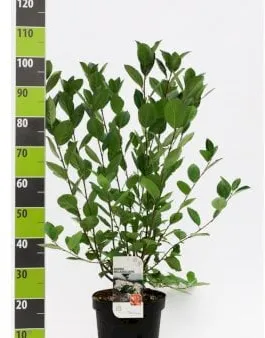
Large-fruited Chokeberry (Aronia melanocarpa) is a medium-sized, deciduous shrub with a dense and upright growth habit. It usually grows 1–2 metres high and 60–90 cm wide and develops an even, well-branched structure that makes it suitable for both untrimmed and trimmed hedges.
The shrub emerges with bronze-coloured leaves that later turn dark green. In spring and early summer, it is covered with many small, white to cream-coloured flowers gathered in round clusters. The flowers attract pollinating insects and have a light scent reminiscent of hawthorn and rowan.
After flowering, black, shiny berries the size of blackcurrants form. They are sour but edible and are often used for juice, jam or as a colouring agent in cooking. The berries are rich in vitamins and antioxidants and are also readily eaten by birds.
In autumn, the shrub displays a striking play of colours in red, copper-red and orange-red shades, giving a decorative effect in the garden over a long period. It thrives in ordinary, well-drained garden soil and tolerates both sun and partial shade without special soil requirements.
Large-fruited Chokeberry is self-pollinating and very hardy. It can be used as a solitary shrub, in groups, in mixed fences or as a hedge plant, where 2–3 plants are usually planted per running metre.
- Decorative deciduous shrub: Combines flowering, berries and autumn colours.
- Edible berries: Black, shiny fruits with a high content of vitamins and antioxidants.
- Bee-friendly: The flowers attract many pollinating insects.
- Hardy and undemanding: Thrives in both sun and partial shade and requires minimal care.
- Suitable for hedge and fence: Forms a dense and even growth without the need for frequent pruning.
Pros and cons
- Robust and winter-hardy plant
- Beautiful autumn colours and decorative berries
- Suitable for both hedge and solitary planting
- Attracts insects and birds
- Requires only ordinary garden soil
- The berries are very sour and require processing before they can be used in cooking
- Can spread if not pruned regularly
Pros and cons
Pros
- Robust and winter-hardy plant
- Beautiful autumn colours and decorative berries
- Suitable for both hedge and solitary planting
- Attracts insects and birds
- Requires only ordinary garden soil
Cons
- The berries are very sour and require processing before they can be used in cooking
- Can spread if not pruned regularly
Pros
- Robust and winter-hardy plant
- Beautiful autumn colours and decorative berries
- Suitable for both hedge and solitary planting
- Attracts insects and birds
- Requires only ordinary garden soil
Cons
- The berries are very sour and require processing before they can be used in cooking
- Can spread if not pruned regularly
Specifications
- Botanical name: Aronia melanocarpa
- Category: Hedge plants / Chokeberry
- Growth habit: Upright and well-branched
- Height: 100–200 cm
- Width: 60–90 cm
- Leaf type: Deciduous
- Leaf colour: Dark green in summer, red to copper-red in autumn
- Flower colour: White to cream-coloured
- Flowering period: May–June
- Fruit colour: Black berries
- Ripening time: August–September
- Light conditions: Full sun to partial shade
- Soil type: Well-drained, nutrient-rich garden soil
- Use: Hedge, fence, groups or solitary shrub
- Bee-friendly: Yes
- Self-pollinating: Yes
- Hardiness: Fully hardy
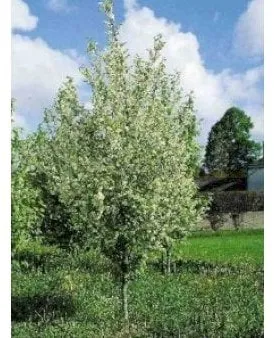
Common Bird Cherry (Prunus padus) is a native tree or large shrub that develops a dense, oval crown. It usually grows 4–8 metres tall, but under good conditions can reach up to 10 metres. The growth is vigorous with a deep root system and many lateral roots, giving the plant a high degree of wind resistance.
The flowers appear in May and are arranged in long, hanging clusters. They are white, five-petalled and have a sweet scent that attracts bees and other pollinators early in the season. The leaves are elliptical with a slightly serrated edge, dark green on the upper side and lighter underneath. The tree leafs out early and is therefore also called May tree.
The fruits are small, dark berries that contain amygdalin (hydrocyanic acid) and should therefore not be eaten by humans. Birds readily eat them and help with dispersal. The species thrives in moist soil and tolerates periodic flooding, making it suitable for planting in low-lying areas, along waterways and in shelterbelts.
The plant is often used in forest and landscape projects, where it contributes to dense vegetation, shelter and increased biodiversity. It can be planted as a solitary tree, in groups or as part of a mixed hedge.
- Growth form: Upright tree or large shrub with an oval crown.
- Height: 4–8 metres, up to 10 metres under good conditions.
- Flowering: White, fragrant flowers in May, attracts bees.
- Fruits: Small, dark berries, not edible for humans but attractive to birds.
- Location: Thrives in moist soil and tolerates flooding.
- Characteristics: Very wind-resistant and suitable for forest and landscape planting.
Pros and cons
- Robust and wind-resistant plant
- Early flowering that supports pollinators
- Tolerates moist soil and flooding
- Suitable for shelterbelts and natural planting
- High value for birds and insects
- The fruits are poisonous to humans
- Can grow large and requires space in the planting
- Vigorous growth may require pruning in smaller gardens
Pros and cons
Pros
- Robust and wind-resistant plant
- Early flowering that supports pollinators
- Tolerates moist soil and flooding
- Suitable for shelterbelts and natural planting
- High value for birds and insects
Cons
- The fruits are poisonous to humans
- Can grow large and requires space in the planting
- Vigorous growth may require pruning in smaller gardens
Pros
- Robust and wind-resistant plant
- Early flowering that supports pollinators
- Tolerates moist soil and flooding
- Suitable for shelterbelts and natural planting
- High value for birds and insects
Cons
- The fruits are poisonous to humans
- Can grow large and requires space in the planting
- Vigorous growth may require pruning in smaller gardens
Specifications
- Botanical name: Prunus padus
- Norwegian name: Common Bird Cherry
- Type: Deciduous tree or large shrub
- Growth form: Upright, oval crown
- Height: 4–8 m (up to 10 m)
- Flowers: White, fragrant, in clusters
- Flowering time: May
- Leaves: Elliptical, serrated, dark green
- Fruits: Small, dark berries (not edible for humans)
- Root system: Deep main roots with branched lateral roots
- Location: Moist soil, tolerates flooding
- Category: Forest and landscape plant
- Variant: Bare root, 2 years (1/1) 30–80 cm
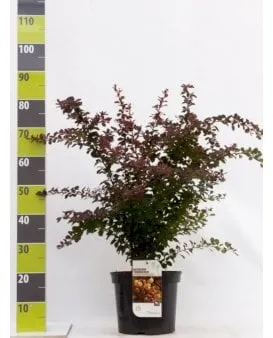
Red barberry for hedge, also known as Berberis thunbergii 'Atropurpurea', is a deciduous shrub with characteristic purple-red, oval leaves. In autumn, the leaves turn bronze-coloured, giving the hedge a striking play of colours throughout the season.
The plant grows at a moderate rate and usually reaches 100–200 cm in height and around 100 cm in width. It has an upright growth habit and is equipped with thorns, making it suitable for hedges that serve as natural boundaries or protection against intruders.
In May–June, barberry blooms with small yellow flowers, which may later be followed by red berries. It thrives best in sun or partial shade and in ordinary garden soil, and it is fully hardy under Norwegian climatic conditions.
Red barberry can be used both as a trimmed and untrimmed hedge, but also as a solitary shrub in plantings where a colourful and robust plant with low maintenance requirements is desired.
- Colourful foliage: Purple-red leaves in summer and bronze-coloured autumn tones.
- Thorny structure: Provides a dense and protective hedge.
- Flowering: Yellow flowers in May–June and red berries later in the season.
- Hardiness: Tolerates the Norwegian climate and requires only moderate fertilisation.
- Placement: Thrives in sun or partial shade in ordinary garden soil.
Pros and cons
- Decorative colour throughout the growing season
- Effective as a protective hedge due to thorns
- Hardy and easy to grow in the Norwegian climate
- Can be used as both a trimmed and untrimmed hedge
- Thorns can make pruning and handling difficult
- Moderate growth – requires patience for full height
- Deciduous, so the hedge loses its leaves in winter
Pros and cons
Pros
- Decorative colour throughout the growing season
- Effective as a protective hedge due to thorns
- Hardy and easy to grow in the Norwegian climate
- Can be used as both a trimmed and untrimmed hedge
Cons
- Thorns can make pruning and handling difficult
- Moderate growth – requires patience for full height
- Deciduous, so the hedge loses its leaves in winter
Pros
- Decorative colour throughout the growing season
- Effective as a protective hedge due to thorns
- Hardy and easy to grow in the Norwegian climate
- Can be used as both a trimmed and untrimmed hedge
Cons
- Thorns can make pruning and handling difficult
- Moderate growth – requires patience for full height
- Deciduous, so the hedge loses its leaves in winter
Specifications
- Latin name: Berberis thunbergii 'Atropurpurea'
- Plant height: approx. 100–200 cm
- Plant width: approx. 100 cm
- Leaf colour: Purple-red, bronze-coloured in autumn
- Flower colour: Yellow
- Flowering period: May–June
- Growth habit: Upright, moderately growing
- Light conditions: Full sun or partial shade
- Soil type: Ordinary garden soil
- Hardiness: Fully hardy in Norway
- Leaf type: Deciduous
- Use: Hedge, solitary shrub, boundary
- Hedge type: Trimmed or untrimmed hedge
- Fertiliser requirement: Moderate
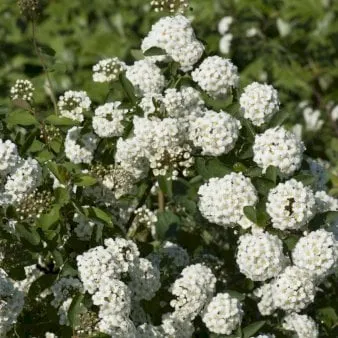
Bridal wreath spirea (Spiraea x vanhouttei) is a deciduous shrub that develops into a medium to large plant with upright and slightly spreading growth. It forms many fine branches that give a dense and harmonious appearance, suitable both as a free-standing shrub and as a hedge.
In May, the plant is covered with a wealth of small, white flowers that sit in round clusters along the young branches. The flowers have a light fragrance and give a distinct, bright expression in the garden. After flowering, small, dry seed capsules develop.
The leaves are small, green and slightly toothed, and in autumn they take on golden to orange shades. Bridal wreath spirea thrives in sun to partial shade and tolerates strong wind. It is fully hardy and grows in most soil types as long as the soil is not waterlogged.
The plant is often used as a clipped or unclipped hedge, but is also suitable for groups or as a solitary ornamental shrub. For hedge planting, three plants per running metre are recommended.
- Rich flowering: Dense, white flowers in May.
- Hardy and robust: Thrives in most soil types and tolerates wind.
- Beautiful autumn colours: The leaves take on golden to orange shades.
- Versatile use: Suitable as a hedge, in groups or as a solitary plant.
- Easy to grow: Requires minimal maintenance and tolerates pruning.
Pros and cons
- Very hardy and easy to grow
- Rich flowering in spring
- Beautiful autumn colours
- Can be used both as a clipped and unclipped hedge
- Tolerates wind and various soil types
- Unclipped hedges can become wide and require space
- Flowering is absent the first year after heavy pruning
- Does not thrive in waterlogged soil
Pros and cons
Pros
- Very hardy and easy to grow
- Rich flowering in spring
- Beautiful autumn colours
- Can be used both as a clipped and unclipped hedge
- Tolerates wind and various soil types
Cons
- Unclipped hedges can become wide and require space
- Flowering is absent the first year after heavy pruning
- Does not thrive in waterlogged soil
Pros
- Very hardy and easy to grow
- Rich flowering in spring
- Beautiful autumn colours
- Can be used both as a clipped and unclipped hedge
- Tolerates wind and various soil types
Cons
- Unclipped hedges can become wide and require space
- Flowering is absent the first year after heavy pruning
- Does not thrive in waterlogged soil
Specifications
- Botanical name: Spiraea x vanhouttei
- Plant category: Hedge plants / Spirea
- Growth form: Upright, well-branched shrub
- Height: Approx. 200 cm
- Width: 90–120 cm
- Leaf colour: Green, with yellow to orange autumn colours
- Leaf type: Deciduous
- Flower colour: White
- Flowering period: May–June
- Fragrance: Lightly fragrant flowers
- Placement: Sun to partial shade
- Wind conditions: Tolerates strong wind
- Hardiness: Fully hardy
- Use: Hedges, groups, solitary shrub
- Planting density for hedge: 3 plants per running metre
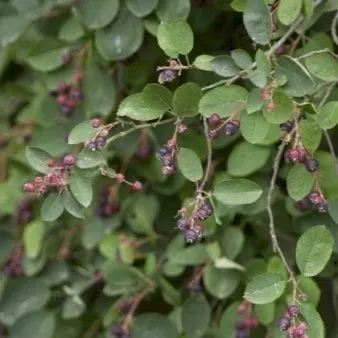
Spike Shadbush (Amelanchier spicata) is a large, deciduous shrub with a naturally slender and upright growth form. It produces many branches and over time develops a dense and twiggy appearance, making it suitable for untrimmed hedges and shelter plantings.
In May and June, the shrub bursts into bloom with many small, white flowers arranged in spikes that attract bees and other pollinators. Later in the summer, small purple to blue-black berries develop, which are quickly eaten by birds.
The leaves are blue-green with a lighter underside and in autumn turn striking shades of yellow to reddish-brown. The bark is smooth and grey-brown, even on older branches, giving the plant an attractive appearance all year round.
Spike Shadbush thrives in most well-drained soil types and tolerates full sun, partial shade and shade. It is wind-resistant and can withstand some salt exposure, making it suitable for exposed locations. It can grow up to around 4 metres tall and 1.5–3 metres wide.
When planting, it is recommended to use nutrient-rich, well-drained soil and to water regularly during establishment. As a hedge, usually 2–3 plants are planted per running metre.
- Flowering: Small white flowers in May–June that attract bees.
- Fruits: Purple to blue-black berries eaten by birds.
- Autumn colours: Yellow to reddish-brown leaves provide a beautiful colour change.
- Growth form: Slender, upright and densely branched shrub up to approx. 4 m tall.
- Robustness: Tolerates wind, salt and varied light conditions.
Pros and cons
- Tolerates wind and salt exposure
- Bee-friendly with abundant flowering
- Bird-friendly with berries in late summer
- Beautiful autumn colours
- Suitable for untrimmed hedges and shelter plantings
- Not ideal for small gardens due to its height
- The berries have limited eating quality for humans
- Requires regular watering during establishment
Pros and cons
Pros
- Tolerates wind and salt exposure
- Bee-friendly with abundant flowering
- Bird-friendly with berries in late summer
- Beautiful autumn colours
- Suitable for untrimmed hedges and shelter plantings
Cons
- Not ideal for small gardens due to its height
- The berries have limited eating quality for humans
- Requires regular watering during establishment
Pros
- Tolerates wind and salt exposure
- Bee-friendly with abundant flowering
- Bird-friendly with berries in late summer
- Beautiful autumn colours
- Suitable for untrimmed hedges and shelter plantings
Cons
- Not ideal for small gardens due to its height
- The berries have limited eating quality for humans
- Requires regular watering during establishment
Specifications
- Botanical name: Amelanchier spicata
- Plant type: Deciduous shrub
- Height: 300–400 cm
- Width: 150–300 cm
- Flowering: May–June
- Flower colour: White
- Leaf colour: Blue-green, autumn yellow to reddish-brown
- Fruit: Purple to blue-black berries
- Light conditions: Full sun, partial shade, shade
- Growing conditions: Well-drained soil, tolerates wind and salt
- Use: Untrimmed hedge, shelter planting, wildlife planting
- Bee-friendly: Yes
- Salt and wind resistance: High
- Planting density: 2–3 plants per running metre
- Category: Hedge plants / Shadbush
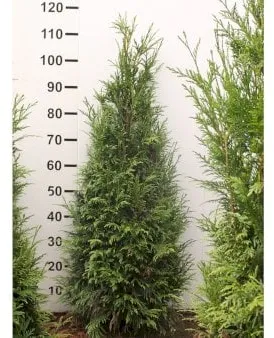
Giant thuja 'Martin' (Thuja plicata 'Martin') is an evergreen conifer with strong, broad columnar growth. It quickly forms a dense and even hedge that provides effective screening and wind protection all year round.
The foliage consists of flat, scale-like leaves in a deep dark green colour that retains its colour through the winter. Young plants often have strong shoots and a more open growth, but quickly become dense with regular trimming.
The variety is very hardy and thrives in most soil types, as long as the soil is not waterlogged. It prefers sun or partial shade and tolerates both wind and cold well.
Giant thuja 'Martin' usually does not flower when kept as a clipped hedge. Unclipped plants, however, can form small, tulip-shaped cones that change from green to light brown.
When planting, it is recommended to ensure good soil quality and drainage. Regular watering and fertilisation during the establishment phase promote a strong root system and dense growth. The hedge can be trimmed to maintain an even shape and density.
- Evergreen: Retains its dark green colour all year round.
- Vigorous growth: Fast-growing and suitable for tall hedges.
- Hardy variety: Tolerates both wind and cold and thrives in many soil types.
- Dense structure: Forms a compact and even hedge with regular trimming.
- Low maintenance: Requires only pruning and watering during the establishment phase.
Pros and cons
- Fast growth and dense structure
- Retains colour all year round
- Very hardy and wind resistant
- Suitable for tall hedges and shelter plantings
- Can become too large for small gardens
- Requires regular watering during the establishment phase
- Young plants may appear open before they become dense
Pros and cons
Pros
- Fast growth and dense structure
- Retains colour all year round
- Very hardy and wind resistant
- Suitable for tall hedges and shelter plantings
Cons
- Can become too large for small gardens
- Requires regular watering during the establishment phase
- Young plants may appear open before they become dense
Pros
- Fast growth and dense structure
- Retains colour all year round
- Very hardy and wind resistant
- Suitable for tall hedges and shelter plantings
Cons
- Can become too large for small gardens
- Requires regular watering during the establishment phase
- Young plants may appear open before they become dense
Specifications
- Botanical name: Thuja plicata 'Martin'
- Norwegian name: Giant thuja 'Martin'
- Plant group: Hedge plants
- Growth form: Broad columnar
- Foliage: Dark green, scale-like, evergreen
- Hardiness: Very hardy and wind resistant
- Light conditions: Sun to partial shade
- Soil type: Most soil types, but not waterlogged
- Typical heights at delivery: 100–120 cm, 160–180 cm, 180–200 cm, 200–225 cm, 280–300 cm
- Delivery form: With root ball or wire ball
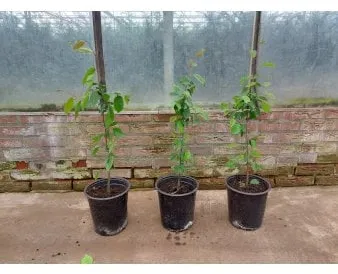
Hornbeam (Carpinus betulus) is a native deciduous plant often used as a hedge due to its dense and well-branched growth. It develops many fine side branches and a continuous leading shoot, giving a compact structure that maintains its density even in the winter months.
The leaves are small, oval, and fresh green with finely serrated edges. In autumn, they take on golden hues, and some of the dry foliage often remains on the branches through winter, providing some screening year-round.
The bark is smooth and grey, while young shoots have a brownish tone with short, soft hairs. The plant flowers in spring with small, hanging catkins, but trimmed hedges rarely produce flowers or fruit.
Hornbeam is very hardy and tolerates both wind, shade, and varying soil conditions. It can grow in both nutrient-rich and heavy soil but thrives best in well-drained garden soil. On light sandy soil, soil improvement is recommended to ensure optimal growth.
When planting as a hedge, about four plants per running metre are recommended to achieve a dense and even hedge. It can also be used in mixed hedges or as a free-standing tree in gardens and parks.
- Dense growth: Forms a compact and well-branched hedge with many fine branches.
- Hardy: Tolerates both wind, shade, and moist soil.
- Seasonal variation: Fresh green foliage in summer and golden autumn colours.
- Low maintenance: Requires only regular trimming to maintain its shape.
- Versatile use: Suitable for hedges, fences, and as a free-standing tree.
Pros and cons
- Robust and wind-resistant plant
- Partially retains foliage in winter
- Thrives in many soil types, including moist soil
- Suitable as a dense hedge or free-standing tree
- Requires regular trimming to maintain density
- Grows slower than some fast-growing hedge species
Pros and cons
Pros
- Robust and wind-resistant plant
- Partially retains foliage in winter
- Thrives in many soil types, including moist soil
- Suitable as a dense hedge or free-standing tree
Cons
- Requires regular trimming to maintain density
- Grows slower than some fast-growing hedge species
Pros
- Robust and wind-resistant plant
- Partially retains foliage in winter
- Thrives in many soil types, including moist soil
- Suitable as a dense hedge or free-standing tree
Cons
- Requires regular trimming to maintain density
- Grows slower than some fast-growing hedge species
Specifications
- Latin name: Carpinus betulus
- Plant type: Deciduous hedge plant
- Flowering period: Spring
- Flower colour: Green
- Leaf colour: Fresh green in summer, golden in autumn
- Autumn colour: Yellow
- Height (fully grown): 1000–1500 cm
- Width: 500–1000 cm
- Growth form: Conical, vigorous growth
- Placement: Sun to partial shade
- Wind conditions: Tolerates strong wind
- Hardiness: Fully hardy
- Leaf type: Deciduous
- Use: Hedges, gardens, and parks
- Planting density as hedge: Approx. 4 plants per running metre
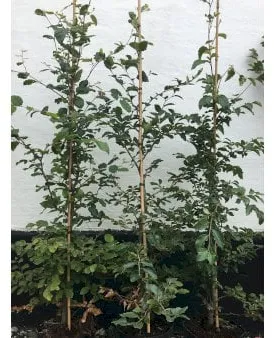
Beech hedge (Fagus sylvatica) is a classic hedge plant that forms a dense and even boundary in the garden. It is characterised by its ability to retain its withered leaves through the winter, providing both structure and screening all year round.
The foliage emerges in spring with light green leaves, which become dark green in the summer months and turn to golden and brown shades in autumn. The withered leaves often remain on the branches until spring, when they are replaced by new foliage.
The plant grows quickly – up to around 30–35 cm per year – and thrives in ordinary, nutrient-rich garden soil. It tolerates pruning well and can be shaped as needed, making it suitable for both low and high hedges.
The beech hedge is fully hardy in the Norwegian climate and requires only moderate maintenance. It is usually planted with 4–5 plants per running metre to achieve a dense and even wall of greenery.
There are several plant types available, including bare-root plants, root-balled plants and potted plants, each suitable for different planting times and establishment conditions.
- Seasonal variation: Changes colour from light green in spring to brown in winter.
- Dense growth: Forms a compact and even hedge that provides effective screening.
- Hardiness: Thrives in the Norwegian climate and tolerates pruning well.
- Flexible placement: Can grow in both sun and shade.
- Fast growth: Typically achieves 30–35 cm growth per year.
Pros and cons
- Retains withered leaves in winter and provides screening all year round
- Tolerates pruning and shaping
- Hardy and adapted to Norwegian conditions
- Can be planted in both sun and shade
- Available in several plant types and sizes
- Requires regular watering during the establishment phase
- Does not thrive in waterlogged soil
- May take a couple of years to become fully dense after planting
Pros and cons
Pros
- Retains withered leaves in winter and provides screening all year round
- Tolerates pruning and shaping
- Hardy and adapted to Norwegian conditions
- Can be planted in both sun and shade
- Available in several plant types and sizes
Cons
- Requires regular watering during the establishment phase
- Does not thrive in waterlogged soil
- May take a couple of years to become fully dense after planting
Pros
- Retains withered leaves in winter and provides screening all year round
- Tolerates pruning and shaping
- Hardy and adapted to Norwegian conditions
- Can be planted in both sun and shade
- Available in several plant types and sizes
Cons
- Requires regular watering during the establishment phase
- Does not thrive in waterlogged soil
- May take a couple of years to become fully dense after planting
Specifications
- Latin name: Fagus sylvatica
- Plant category: Hedge plants
- Hedge type: Clipped hedge
- Leaf type: Deciduous
- Leaf colour: Green in summer, brown in winter
- Autumn colour: Brown to yellow-brown
- Growth: Vigorous, approx. 30–35 cm per year
- Hardiness: Fully hardy in Norway
- Placement: Sun / shade
- Optimal growing conditions: Nutrient-rich, well-drained garden soil
- Plant spacing: 25 cm (4–5 plants per metre)
- Use: Hedges, parks, boundaries
- Height (mature plant): 100–200 cm depending on pruning
- Width: 50–100 cm
- Leaf shape: Oval
- Bark/branch colour: Greyish
- Fruit colour: Brown
- Ripening time: September–October
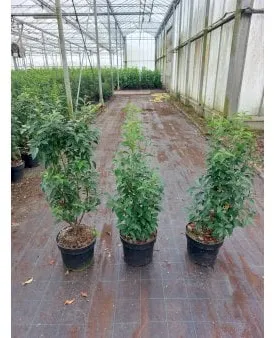
Portuguese laurel, botanically known as Prunus lusitanica 'Angustifolia', is a medium to large evergreen shrub with dense and harmonious growth. It is often used as a hedge plant but can also stand as a solitary shrub in the garden.
The plant has oval, dark green leaves with a glossy surface, which contrast with the reddish petioles. This colour combination provides an elegant and decorative appearance all year round.
Early in summer, older plants develop short, upright clusters of small, white, lightly scented flowers. After flowering, black, inedible berries form, which are quickly eaten by birds.
The growth is moderately vigorous and dense, making the plant well suited for hedges that provide effective screening. It thrives best in ordinary, nutrient-rich and well-drained garden soil and can grow in both sun and shade.
For optimal establishment, regular watering is recommended during the first few years, preferably with a drip hose. The plant tolerates pruning and can be shaped as needed, but should be placed in shelter to avoid leaf scorch from strong wind or frost.
- Evergreen: Retains its dark green foliage all year round.
- Decorative contrast: Reddish petioles provide an elegant colour play against the green leaves.
- Suitable for hedges: Dense and harmonious growth that provides good screening.
- Blooms in summer: Small white flowers with a light scent on older plants.
- Robust and hardy: Less frost-sensitive than many other cherry laurel varieties.
Pros and cons
- Dense and evergreen growth all year round
- Can be used as both clipped and unclipped hedge
- Decorative with dark green foliage and reddish stems
- Relatively hardy and robust
- Attracts birds with its berries
- Can get leaf scorch in strong wind or frost
- Requires regular watering during establishment
- Grows moderately, so it takes time to reach full hedge height
Pros and cons
Pros
- Dense and evergreen growth all year round
- Can be used as both clipped and unclipped hedge
- Decorative with dark green foliage and reddish stems
- Relatively hardy and robust
- Attracts birds with its berries
Cons
- Can get leaf scorch in strong wind or frost
- Requires regular watering during establishment
- Grows moderately, so it takes time to reach full hedge height
Pros
- Dense and evergreen growth all year round
- Can be used as both clipped and unclipped hedge
- Decorative with dark green foliage and reddish stems
- Relatively hardy and robust
- Attracts birds with its berries
Cons
- Can get leaf scorch in strong wind or frost
- Requires regular watering during establishment
- Grows moderately, so it takes time to reach full hedge height
Specifications
- Botanical name: Prunus lusitanica 'Angustifolia'
- Plant category: Hedge plants / Cherry laurel
- Type: Evergreen shrub
- Growth form: Upright and densely branched
- Height: Up to approx. 250 cm (can be kept lower by pruning)
- Width: 120–150 cm
- Leaf colour: Dark green with reddish stems
- Leaf shape: Oval, pointed
- Flower colour: White
- Flowering period: June (early summer)
- Fruit colour: Black (inedible)
- Light conditions: Sun to shade
- Soil type: Nutrient-rich, well-drained garden soil
- Hardiness: Fully hardy, but best in shelter
- Fragrance: Lightly scented flowers
- Use: Clipped or unclipped hedge, free-standing shrub
- Growth rate: Moderate growing
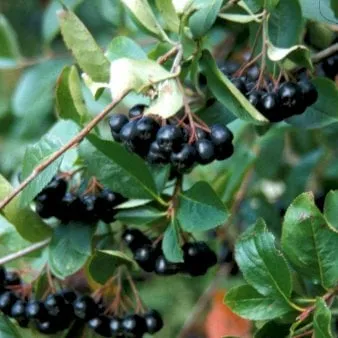
Large-fruited Chokeberry (Aronia melanocarpa) is a medium-sized, well-branched shrub with a dense, oval growth habit. It develops evenly and forms a compact crown, making it suitable for both hedges and free-standing plantings.
In spring, the leaves emerge with a bronze tint, later turning dark green. In autumn, the shrub displays striking colours in shades of red, purple-red and orange-red, providing a decorative appearance over a long period.
Flowering occurs as the leaves unfold, when many small cream-white to white flowers gather in round clusters. The flowers attract pollinating insects, and the plant is self-pollinating.
After flowering, black, glossy berries about the size of blackcurrants form. They are sour but edible and are often used for juice, jam or as a natural colouring in cooking. The berries are rich in vitamins and antioxidants and attract birds in late summer.
The shrub thrives in ordinary, well-drained garden soil and requires no special growing conditions. It tolerates both sun and partial shade and is fully hardy. It can be used as an untrimmed or trimmed hedge, in mixed hedgerows or as a solitary ornamental plant.
- Decorative foliage colour: Bronze-coloured leaves when emerging and red autumn colours.
- Abundant flowering: Many white flowers in round clusters in spring.
- Edible berries: Black, glossy berries with a high content of vitamins and antioxidants.
- Hardy and undemanding: Thrives in most soil types and tolerates both sun and partial shade.
- Versatile use: Suitable as a hedge, ornamental shrub or in mixed plantings.
Pros and cons
- High hardiness and low maintenance requirements
- Beautiful colours throughout the season
- Attracts insects and birds
- Can be used both as a hedge and a solitary shrub
- Berries can be used for juice and jam
- The berries are very sour and require processing before they can be used in cooking
- Can spread if not pruned regularly
Pros and cons
Pros
- High hardiness and low maintenance requirements
- Beautiful colours throughout the season
- Attracts insects and birds
- Can be used both as a hedge and a solitary shrub
- Berries can be used for juice and jam
Cons
- The berries are very sour and require processing before they can be used in cooking
- Can spread if not pruned regularly
Pros
- High hardiness and low maintenance requirements
- Beautiful colours throughout the season
- Attracts insects and birds
- Can be used both as a hedge and a solitary shrub
- Berries can be used for juice and jam
Cons
- The berries are very sour and require processing before they can be used in cooking
- Can spread if not pruned regularly
Specifications
- Botanical name: Aronia melanocarpa
- Plant form: Medium-sized, well-branched shrub
- Height: 100–200 cm
- Width: 60–90 cm
- Leaf type: Deciduous
- Leaf colour: Dark green in summer, reddish in autumn
- Flower colour: Cream-white to white
- Flowering period: May–June
- Fruit colour: Black
- Fruit type: Edible berries
- Ripening time: August–September
- Light conditions: Full sun to partial shade
- Soil type: Well-drained, nutrient-rich garden soil
- Hardiness: Fully hardy
- Pollination: Self-pollinating
- Use: Hedge, ornamental shrub, fruit bush
- Plant spacing as hedge: 2–3 plants per running metre
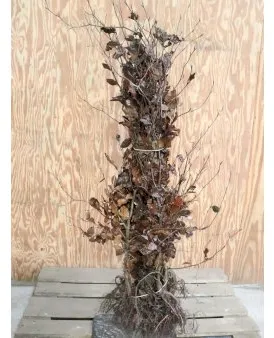
Copper beech (Fagus sylvatica purpurea) is a variant of common beech characterised by its reddish to purple-red foliage. The colour becomes most intense when the plant stands in full sun, but it also thrives in partial shade. The leaves turn a bronze tone in autumn, and the withered leaves often remain on the branches through winter, giving the hedge a dense appearance all year round.
The plant is fully hardy in Norway and grows vigorously with an annual growth of up to about 35 cm. It is suitable for clipped hedges and can be shaped as needed. To achieve a dense hedge, it is recommended to plant 4–5 plants per metre.
Copper beech is best planted in nutrient-rich, well-drained garden soil. The roots should be placed in a trench of at least 30x30 cm, and it is important that they are not bent upwards. In heavy clay soil, the soil can be loosened and gravel or sand added for better drainage, while light sandy soil can advantageously be improved with soil conditioner. Regular watering and fertilisation during the growing season promote establishment and growth.
Copper beech is available as bare-root, root-ball or potted plants. Bare-root plants are the most common type for hedges and are typically planted from October to June, while root-ball and potted plants can be used over a longer season.
- Red foliage: Deep reddish leaves that become more intense in sunlight.
- Hardiness: Tolerates the Norwegian climate and is resistant to diseases.
- Dense growth: Forms a compact hedge with 4–5 plants per metre.
- Annual growth: Up to approx. 35 cm per year under good conditions.
- Flexible plant type: Available as bare-root, root-ball or potted plant.
Pros and cons
- Decorative colour variation throughout the season
- Suitable for both sun and partial shade
- Fully hardy and disease resistant
- Can be shaped and trimmed as needed
- Partially retains its leaves in winter
- Colour intensity depends on the amount of sun
- Requires regular watering during establishment
- Bare-root plants must be handled quickly to avoid drying out
Pros and cons
Pros
- Decorative colour variation throughout the season
- Suitable for both sun and partial shade
- Fully hardy and disease resistant
- Can be shaped and trimmed as needed
- Partially retains its leaves in winter
Cons
- Colour intensity depends on the amount of sun
- Requires regular watering during establishment
- Bare-root plants must be handled quickly to avoid drying out
Pros
- Decorative colour variation throughout the season
- Suitable for both sun and partial shade
- Fully hardy and disease resistant
- Can be shaped and trimmed as needed
- Partially retains its leaves in winter
Cons
- Colour intensity depends on the amount of sun
- Requires regular watering during establishment
- Bare-root plants must be handled quickly to avoid drying out
Specifications
- Latin name: Fagus sylvatica purpurea
- Plant height (variant): 80–100 cm, bare-root, 3 years (1/2)
- Use: Hedge
- Leaf colour: Red to purple-red
- Autumn colour: Bronze
- Leaf type: Deciduous
- Light conditions: Full sun or partial shade
- Growth: Medium-growing, up to approx. 35 cm per year
- Hardiness: Fully hardy in Norway
- Growth form: Broad-crowned, clipped hedge
- Plant spacing: 4–5 plants per metre
- Soil type: Nutrient-rich and well-drained garden soil
- Fertilisation: Moderate
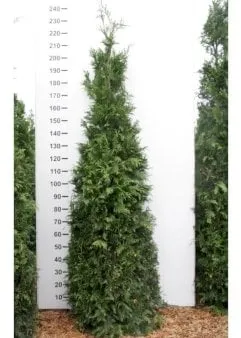
Giant thuja 'Martin' (Thuja plicata 'Martin') is an evergreen conifer with a strong, broad columnar growth. It quickly forms a dense and even hedge that provides effective screening and shelter in the garden. The foliage consists of flat, scale-like leaves in a deep dark green colour that retains its freshness all year round.
The variety is known for its hardiness and thrives in most soil types, as long as the soil is not waterlogged. It prefers sun or partial shade and tolerates both wind and cold. Young plants often have a more open growth habit but quickly become dense with regular trimming.
Giant thuja 'Martin' only produces small, tulip-shaped cones if it is not trimmed. It requires consistent watering during the establishment phase and benefits from regular fertilisation to develop a strong root system. The variety is best suited for larger gardens or areas where a tall and robust hedge is desired.
- Evergreen growth: Retains its dark green colour all year round.
- Vigorous and fast-growing: Quickly forms a dense and tall hedge.
- Hardy and wind-resistant: Thrives in the Norwegian climate and tolerates exposed locations.
- Easy to shape: Can be trimmed into an even and elegant hedge.
- Suitable for larger gardens: Ideal for tall hedges and shelter plantings.
Pros and cons
- Fast growth and dense structure
- Retains colour all year round
- Tolerates wind and cold
- Suitable for tall hedges and shelter plantings
- Requires regular watering and fertilisation during establishment
- Can become too large for small gardens
- Young plants may appear open in growth before trimming
Pros and cons
Pros
- Fast growth and dense structure
- Retains colour all year round
- Tolerates wind and cold
- Suitable for tall hedges and shelter plantings
Cons
- Requires regular watering and fertilisation during establishment
- Can become too large for small gardens
- Young plants may appear open in growth before trimming
Pros
- Fast growth and dense structure
- Retains colour all year round
- Tolerates wind and cold
- Suitable for tall hedges and shelter plantings
Cons
- Requires regular watering and fertilisation during establishment
- Can become too large for small gardens
- Young plants may appear open in growth before trimming
Specifications
- Botanical name: Thuja plicata 'Martin'
- Norwegian name: Giant thuja 'Martin'
- Plant group: Hedge plant
- Growth form: Broad columnar
- Foliage: Scale-like, dark green leaves
- Hardiness: Very hardy and wind-resistant
- Light conditions: Sun to partial shade
- Soil type: Most soil types, but not waterlogged
- Cones: Small, tulip-shaped (only on untrimmed plants)
- Varieties: With root ball (100–120 cm, 160–180 cm, 180–200 cm, 200–225 cm), Wire root ball (200–225 cm, 280–300 cm)
Læs også: